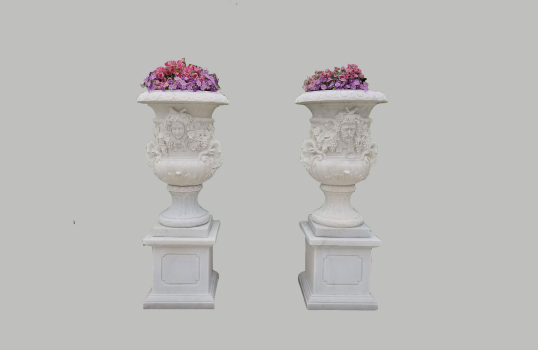
Marble carving
Marble carving is the branch of the visual arts that operates in three dimensions. It is one of the plastic arts. Durable sculptural processes originally used carving (the removal of material) and modelling (the addition of material, as clay), in stone, metal, ceramics, wood and other materials but, since Modernism, there has been an almost complete freedom of materials and process. A wide variety of materials may be worked by removal such as carving, assembled by welding or modelling, or molded, or cast.
Marble carving in stone survives far better than works of art in perishable materials, and often represents the majority of the surviving works (other than pottery) from ancient cultures, though conversely traditions of marble carving in wood may have vanished almost entirely. However, most ancient marble carving was brightly painted, and this has been lost.
Marble carving has been central in religious devotion in many cultures, and until recent centuries large marble carvings, too expensive for private individuals to create, were usually an expression of religion or politics. Those cultures whose marble carvings have survived in quantities include the cultures of the ancient Mediterranean, India and China, as well as many in South America and Africa.
The Western tradition of marble carving began in ancient Greece, and Greece is widely seen as producing great masterpieces in the classical period. During the Middle Ages, Gothic marble carving represented the agonies and passions of the Christian faith. The revival of classical models in the Renaissance produced famous marble carvings such as Michelangelo's David. Modernist marble carving moved away from traditional processes and the emphasis on the depiction of the human body, with the making of constructed marble carving, and the presentation of found objects as finished art works.
The collecting of marble carving, including that of earlier periods, goes back some 2,000 years in Greece, China and Mesoamerica, and many collections were available on semi-public display long before the modern museum was invented. From the 20th century the relatively restricted range of subjects found in large marble carving expanded greatly, with abstract subjects and the use or representation of any type of subject now common. Today much marble carving is made for intermittent display in galleries and museums, and the ability to transport and store the increasingly large works is a factor in their construction. Small decorative figurines, most often in ceramics, are as popular today (though strangely neglected by modern and Contemporary art) as they were in the Rococo, or in ancient Greece when Tanagra figurines were a major industry, or in East Asian and Pre-Columbian art. Small sculpted fittings for furniture and other objects go well back into antiquity, as in the Nimrud ivories, Begram ivories and finds from the tomb of Tutankhamun.
Portrait Marble carving began in Egypt, where the Narmer Palette shows a ruler of the 32nd century BCE, and Mesopotamia, where we have 27 surviving statues of Gudea, who ruled Lagash c. 2144 – 2124 BCE. In ancient Greece and Rome, the erection of a portrait statue in a public place was almost the highest mark of honour, and the ambition of the elite, who might also be depicted on a coin.[5] In other cultures such as Egypt and the Near East public statues were almost exclusively the preserve of the ruler, with other wealthy people only being portrayed in their tombs. Rulers are typically the only people given portraits in Pre-Columbian cultures, beginning with the Olmec colossal heads of about 3,000 years ago. East Asian portrait marble carving was entirely religious, with leading clergy being commemorated with statues, especially the founders of monasteries, but not rulers, or ancestors. The Mediterranean tradition revived, initially only for tomb effigies and coins, in the Middle Ages, but expanded greatly in the Renaissance, which invented new forms such as the personal portrait medal.
Animals are, with the human figure, the earliest subject for marble carving, and have always been popular, sometimes realistic, but often imaginary monsters; in China animals and monsters are almost the only traditional subjects for stone marble carving outside tombs and temples. The kingdom of plants is important only in jewellery and decorative reliefs, but these form almost all the large marble carving of Byzantine art and Islamic art, and are very important in most Eurasian traditions, where motifs such as the palmette and vine scroll have passed east and west for over two millennia.
One form of Marble carving found in many prehistoric cultures around the world is specially enlarged versions of ordinary tools, weapons or vessels created in impractical precious materials, for either some form of ceremonial use or display or as offerings. Jade or other types of greenstone were used in China, Olmec Mexico, and Neolithic Europe, and in early Mesopotamia large pottery shapes were produced in stone. Bronze was used in Europe and China for large axes and blades, like the Oxborough Dirk.
Hot Products


People who liked this story also liked